
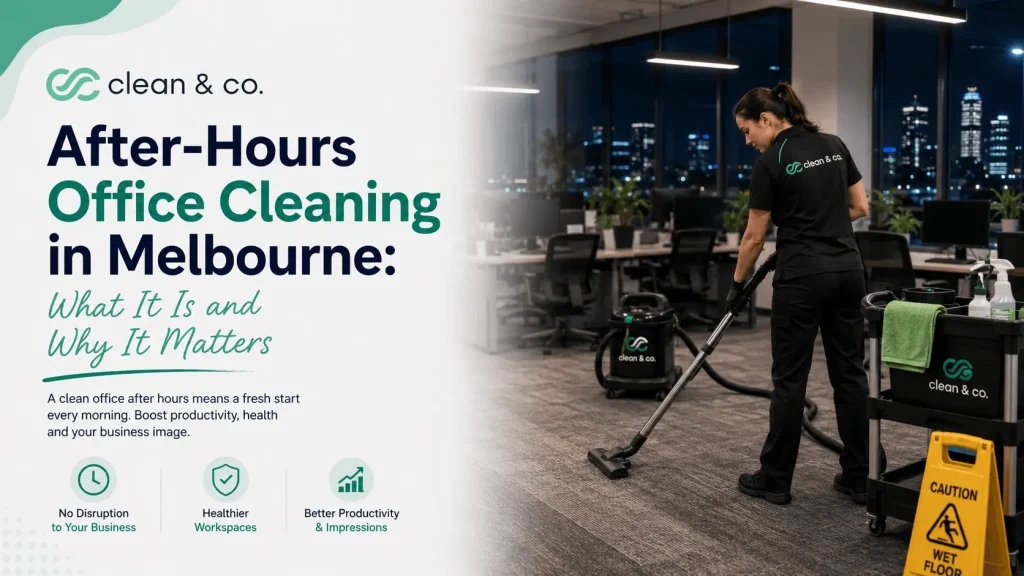
Most Melbourne businesses have their offices cleaned when no one is there. That is not a coincidence. After-hours cleaning has become the default for professional workplaces across Melbourne’s CBD, inner suburbs, and commercial precincts for practical reasons that have less to do with convenience and more to do with quality, efficiency, and workplace management.
This guide explains what after-hours office cleaning actually involves, why it works better than cleaning during business hours for most workplaces, how the Melbourne CBD context shapes the logistics, and what the shift to hybrid work has changed about how businesses schedule it.
What After-Hours Office Cleaning Actually Means
After-hours office cleaning refers to professional cleaning services scheduled outside standard business hours: typically after staff leave in the evening or before they arrive in the morning. In Melbourne, the two most common windows are:
Evening cleaning (6pm to 10pm): The most common schedule for offices in the CBD and inner suburbs. Cleaners arrive after the last staff member leaves, complete the full scope of work, and secure the premises when done.
Early morning cleaning (4am to 8am): Popular with businesses that want a freshly cleaned office at the start of each day without cleaners overlapping with early starters. One Melbourne office cleaning company notes that their most popular booking window for CBD clients is 6am to 8am.
Overnight cleaning: Used for larger premises, multi-floor tenancies, and facilities with a more intensive cleaning scope. Cleaners work through the night to ensure the full building is ready by 7am.
Some businesses also use a split approach: quieter tasks like surface wiping and rubbish removal completed during business hours, with vacuuming, floor mopping, and bathroom cleans done in the evening window to avoid noise disruption.
Why Most Melbourne Businesses Choose After-Hours Cleaning
Cleaners Can Work Without Interruption
When an office is occupied, cleaning becomes partial. High-traffic areas can be attended to, but workstations with people at them, meeting rooms in use, and floors blocked by foot traffic all limit what a cleaner can actually do without causing disruption.
After hours, none of those constraints apply. Every workstation is accessible. Every floor section can be vacuumed and mopped. Every meeting room can be properly attended to. The result is a more thorough clean in the same amount of time – or the same standard of clean in less time.
Staff Productivity Is Not Affected
Vacuum noise in an open-plan office during a meeting, a wet floor sign blocking access to the kitchen, or a cleaner moving through a workstation area while people are trying to concentrate all create low-level friction that adds up. After-hours cleaning removes this entirely.
This is particularly relevant in smaller Melbourne offices where open-plan layouts mean cleaning activity is visible and audible across the whole workspace.
Access Is Unrestricted
Locked drawers, personal items left on desks, and occupied rooms all limit how thoroughly a daytime clean can be done. After hours, cleaners have unobstructed access to every area within the agreed scope, which directly affects the standard of the result.
First Impressions Are Set Fresh Each Morning
An office cleaned the previous evening – or in the early morning before staff arrive – is at its best when the first person walks in. No residual grime from the previous day sits until cleaning time. Client meetings held in the morning start in a clean space, not one due for its evening clean.
💡 Clean & Co Note: Our commercial cleaning service operates on after-hours schedules across Melbourne’s CBD, inner suburbs, and surrounding business precincts. We work around your hours and your access arrangements, and we provide a documented completion report before your team arrives each morning. Request a commercial cleaning proposal tailored to your premises and schedule.
The Melbourne CBD Context: Access, Parking, and Building Management
After-hours office cleaning in Melbourne’s CBD involves logistical considerations that suburban office cleaning does not. Professional commercial cleaning companies operating in the CBD are familiar with these requirements. Businesses setting up a cleaning arrangement for a CBD tenancy should confirm them explicitly.
Building Access Protocols
Most Melbourne CBD buildings have after-hours access systems that require cleaners to sign in, carry a specific access card or fob, and follow building management protocols for entry and exit. Some buildings require cleaning staff to be inducted by building management before they can access the tenancy.
A professional cleaning company with CBD experience will have managed these requirements across many buildings and can navigate the process without it becoming your administrative burden.
Confirm with any prospective provider:
- How do your staff access the premises after hours?
- Are your cleaners inducted or can they be inducted into our building’s system?
- Who holds the access credentials and how are they managed if a team member changes?
- What is your process for securing the premises when cleaning is complete?
Parking and Travel
CBD parking restrictions and costs add a logistical layer to after-hours cleaning in Melbourne that does not exist in suburban offices. Professional providers factor this into their operations. It is worth confirming that the provider you choose has a clear process for CBD access rather than assuming it.
Building Management Requirements
Some Melbourne CBD and strata buildings specify which cleaning companies are approved to operate on the premises, or require providers to hold particular certifications or insurance levels. Check with your building manager before signing a cleaning contract to confirm whether any such restrictions apply.
Hybrid Work and After-Hours Cleaning: The 2026 Reality
The shift to hybrid working has changed the cleaning landscape for Melbourne offices in a meaningful way. By 2026, most Melbourne CBD offices are occupied 3 to 4 days per week on average, with Tuesday, Wednesday, and Thursday being the peak occupancy days for most businesses.
Cleaning every day in a five-day cycle no longer makes sense for many offices. Cleaning an empty or near-empty office on a Monday after a quiet Friday produces a similar result to cleaning it less frequently and more intensively.
Forward-thinking Melbourne businesses are now using demand-responsive scheduling: cleaning is concentrated on the days before and after peak occupancy, with periodic deep cleans handling the intensive tasks. This approach maintains presentation standards while reducing unnecessary cleaning spend on low-occupancy days.
What this looks like in practice:
Standard schedule (pre-hybrid): Nightly cleaning, Monday to Friday.
Demand-responsive schedule (hybrid-adapted): Cleaning on Monday evening, Wednesday evening, and Friday evening, with a monthly deep clean covering carpets, glass, and high areas.
The right frequency depends on your occupancy pattern, the nature of your workspace, and client visit requirements. A practice with daily client appointments has different needs from a team that is mostly remote with shared desk use on Wednesdays and Thursdays.
💡 Clean & Co Note: We tailor after-hours cleaning schedules to actual usage patterns, not arbitrary defaults. If your team is in three days a week, your cleaning scope and frequency should reflect that. Speak with our commercial team about scheduling options that match how your office actually operates in 2026.
What After-Hours Cleaning Covers
The scope of work does not change because cleaning happens after hours. The timing changes; the tasks do not. A standard after-hours office cleaning contract covers the same items as any commercial cleaning scope.
Each visit typically includes:
- Emptying all bins (general waste and recycling)
- Vacuuming all carpeted areas
- Mopping all hard floors
- Cleaning and sanitising bathrooms (toilets, sinks, mirrors, floors, restocking consumables)
- Cleaning the kitchen or breakroom (benchtops, sink, appliance exteriors, floor)
- Wiping down and sanitising high-touch surfaces (door handles, light switches, shared equipment)
- Cleaning glass entry doors and reception area surfaces
- Dusting surfaces and ledges accessible without moving furniture
Periodic tasks (monthly or quarterly, depending on contract):
- Carpet steam cleaning
- Window cleaning (internal and external)
- Hard floor polishing
- High dusting (ceilings, vents, light fittings)
- Deep kitchen cleans (inside appliances)
The key difference with after-hours cleaning is that all areas can be properly accessed and attended to, without the constraints that occupy a daytime clean. That access is the core operational advantage.
How Access and Security Are Managed
Handing over access to your premises is a reasonable concern for any business. Professional commercial cleaning providers manage this through a combination of staff vetting and structured access procedures.
Staff vetting: Any reputable commercial cleaning company should be able to confirm that all staff attending your premises have undergone police checks and identity verification. This should be offered proactively as part of the proposal, not something you have to ask for.
Key and access management: Physical keys and electronic access credentials should be logged, documented, and assigned to named individuals. Ask your provider to describe their key management process specifically – how access is issued, what happens when a team member changes, and what is the process if credentials are lost or compromised.
Completion documentation: Many professional Melbourne providers now send a digital completion report – including timestamped confirmation and, where applicable, photographic evidence – before 7am after each clean. This gives the office manager visibility without needing to be on site.
Your building’s requirements: Some commercial buildings require cleaners to sign in and out via a building management system, or to be escorted during initial access periods. Confirm your building’s specific requirements with building management before your cleaning arrangement starts.
How After-Hours Timing Affects Cost
After-hours cleaning attracts penalty rates under the Cleaning Services Award 2020. Cleaners working between 6pm and 6am on weekdays, on Saturdays, Sundays, or public holidays are entitled to loadings above the ordinary time rate.
This is factored into commercial cleaning quotes for after-hours schedules. Any quote that appears to offer after-hours cleaning at the same rate as daytime cleaning without explanation should be questioned – Award-compliant wages for after-hours work cost more, and a quote that doesn’t reflect this is either absorbing the cost somewhere else or not paying correctly.
For a full breakdown of commercial cleaning costs in Melbourne including how after-hours rates affect pricing, see our guide on how much office cleaning costs in Melbourne.
Setting Up After-Hours Cleaning: What to Discuss With Your Provider
Before an after-hours cleaning arrangement starts, align on the following with your prospective provider:
Access logistics
- How will your cleaners access the premises?
- Who holds the keys or access credentials?
- What is the handover and security process at the end of each clean?
- Are there building management requirements to satisfy first?
Timing
- What time window works for your building and your team?
- Do you have staff who frequently work late that could conflict with an early evening schedule?
- Are there specific nights that should be avoided (late client events, after-hours meetings)?
Frequency
- How many days per week does the office need cleaning?
- Does your hybrid work pattern mean some days are low-occupancy and need lighter attention?
- Are there periodic tasks to schedule (carpet cleaning, window cleaning) and on what cycle?
Communication
- How will you receive confirmation that each clean has been completed?
- Who is your named point of contact for issues?
- What is the process for a one-off urgent clean request (post-event, spill, pre-inspection)?
Contingency
- What happens if your scheduled cleaner is unavailable?
- Is there a documented backup process or will you be notified and left without a clean?
These conversations take 15 minutes before a contract starts. They prevent weeks of frustration after one does.
For guidance on what to look for when evaluating commercial cleaning providers more broadly, see our post on how to choose a commercial cleaning company in Melbourne.
💡 Clean & Co Note: Every after-hours commercial cleaning arrangement we manage includes a documented access protocol, a named account manager, and a digital completion report before your team arrives in the morning. We are fully insured, our staff are police-checked, and we operate across Melbourne’s CBD and surrounding precincts on flexible after-hours schedules. Book a no-obligation site assessment and we will put together a proposal built around your actual hours and occupancy pattern.
This guide reflects commercial cleaning industry practice in Melbourne as of 2025-2026. Award rate references reflect the Cleaning Services Award 2020. Building access requirements vary by tenancy and building management arrangement.