
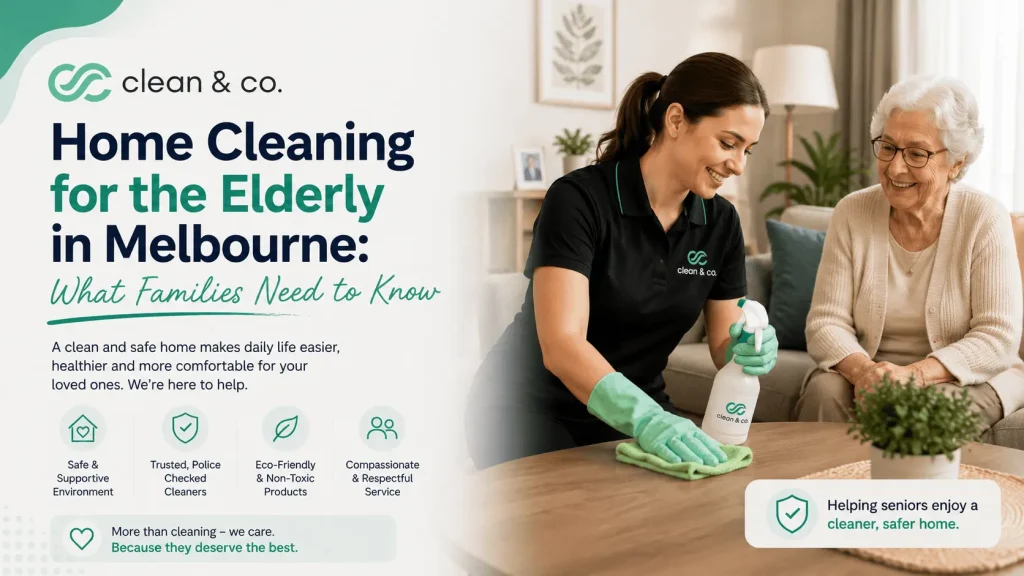
Arranging professional cleaning for an elderly parent is often more complicated than it first appears. It involves logistics, yes – but also a conversation with your parent about accepting help, a decision about who you trust in their home, and for many Melbourne families, navigating a government funding system that has changed significantly in the past 12 months.
This guide covers the practical and the personal: what funding is available, what to look for in a cleaner working with an older person, how to handle the conversation with your parent, and what a genuinely good cleaning arrangement looks like for an elderly person living at home.
Why Cleaning Matters More Than It Might Seem
For older Australians living independently, a clean home is not just about appearance. It is directly connected to health, safety, and dignity.
Health and hygiene: Elderly people are more susceptible to respiratory illness, infection, and the effects of allergens than younger adults. Dust accumulation, bathroom mould, uncleaned kitchen surfaces, and neglected high-touch points (door handles, tapware, light switches) present real health risks for someone with reduced immunity or a chronic condition.
Safety: Clutter, wet floors, and accumulated grime on hard floor surfaces all increase fall risk. Falls are the leading cause of injury hospitalisation for older Australians. A consistently clean, uncluttered home directly reduces this risk.
Independence and dignity: The ability to live in a clean, comfortable home – without relying on family to manage the cleaning themselves – preserves independence in a way that matters deeply to most older people. Professional cleaning arranged thoughtfully allows your parent to maintain their standard of living without feeling like a burden on you.
Mental wellbeing: Research consistently links clean, ordered living environments to better mood and reduced anxiety in older adults. For someone who has managed their own household for decades, letting the cleanliness of that home slip can be distressing.
Funding Options Available to Melbourne Families
Depending on your parent’s age, circumstances, and care needs, there are several pathways to subsidised or funded cleaning support in Melbourne. This landscape changed significantly in November 2025.
1. Support at Home Program (from 1 November 2025)
The Australian Government’s Support at Home program replaced the Home Care Packages Program on 1 November 2025. It is the primary government-funded pathway for older Australians who need help at home, including domestic cleaning.
Support at Home is available to people who are aged 65 or older (or 50 and over for Aboriginal and Torres Strait Islander people), and who have been assessed as needing support to remain living safely and independently at home.
What it covers: Domestic cleaning falls under the “Everyday Living” category of Support at Home, which includes cleaning, laundry, meal preparation, and household tasks.
Cost contribution: Under Support at Home, participants contribute toward the cost of Everyday Living services based on their financial situation. Full pensioners contribute 17.5% of everyday living costs. Self-funded retirees contribute up to 80%. Clinical care services (nursing, wound management) are fully government-funded with no personal contribution required.
Funding levels: Support at Home operates across eight funding classifications, with quarterly budgets offering up to $78,106 per year at the highest level. The right classification is determined by an assessment of your parent’s care needs.
How to access it:
- Call My Aged Care on 1800 200 422 or visit myagedcare.gov.au
- Register and request an assessment
- An assessor will visit your parent at home and determine their funding classification
- Once approved, choose a registered Support at Home provider in Melbourne
- Work with the provider to build a care plan that includes cleaning
If your parent was already receiving a Home Care Package before November 2025, they will have been transitioned to an equivalent Support at Home classification automatically.
2. Commonwealth Home Support Programme (CHSP)
The Commonwealth Home Support Programme provides entry-level support for older Australians with lower-level needs. It is still operating separately from Support at Home and will not transition to the new program until at least July 2027.
CHSP is the right pathway if your parent needs light assistance with cleaning and household tasks but does not yet require the more comprehensive support covered by the full Support at Home program. It is also an important option while waiting for a Support at Home assessment to be completed.
CHSP is coordinated through My Aged Care and delivered by registered providers across Melbourne. Contributions are lower than under Support at Home.
3. NDIS (for people under 65 with a disability)
For family members arranging cleaning support for someone under 65 who has a disability, the National Disability Insurance Scheme (NDIS) may fund domestic assistance.
Under the NDIS, cleaning is funded under “Assistance with Daily Life” (Support Category 01) as part of Core Supports. As of July 2025, the capped hourly rate for NDIS cleaning services in metropolitan Melbourne is approximately $58.03 per hour.
Eligibility requires that the person’s disability genuinely prevents them from safely completing cleaning tasks independently. The NDIS funds routine cleaning of the rooms the person uses – bathroom, kitchen, bedroom, living room – but does not cover one-off specialist services such as carpet steam cleaning, bond cleaning, or pest control.
4. Private Pay
If your parent does not qualify for government-funded support, or prefers to arrange cleaning privately outside a funded program, private residential cleaning is available across Melbourne at standard market rates. For a general guide to residential cleaning costs in Melbourne, our post on how much a house cleaner costs in Melbourne covers pricing by property size and frequency.
💡 Clean & Co Note: Our aged care cleaning service is available to Melbourne families arranging cleaning for an elderly parent, whether privately arranged or as part of a funded support plan. We use eco-friendly, non-toxic products throughout – which matters particularly for clients with respiratory sensitivities or allergies – and we match the same cleaner to each visit for the consistency that older clients value and deserve. Speak with our team about aged care cleaning options before you book.
What to Look for in a Cleaner for an Elderly Person
Choosing a cleaner to work in the home of an older, potentially vulnerable person requires different criteria than a standard residential cleaning arrangement. The following are non-negotiable for most families in this situation.
Police Check and Identity Verification
Any cleaner working in the home of an elderly person should be police-checked. This is a basic safeguard and any reputable cleaning company should offer this as a standard part of their service. Ask specifically – do not assume it is covered.
Identity verification (confirming that the person who turns up is the person who was vetted) is equally important, particularly for repeat visits.
Consistent Same-Person Service
This is the single most important factor for most elderly clients and their families, above price and even above technical cleaning skill.
An older person allowing someone into their home is placing a significant degree of trust in that individual. That trust is built over time and is specific to a person, not a company logo. A cleaning service that sends a different team member each visit – either by design or through poor rostering – requires the elderly person to manage that uncertainty repeatedly, which is distressing for many older people.
Before booking, ask directly: will the same person come each visit, and what happens if they are unavailable?
Sensitivity and Respect
The way a cleaner behaves in an elderly person’s home matters as much as the quality of the clean. An older person’s home contains their life – their photographs, their routines, their familiar arrangement of things. A cleaner who moves items without discussion, works quickly without acknowledging the client, or makes the older person feel like an inconvenience in their own space has not done the job properly, regardless of the physical cleaning result.
When evaluating a cleaning company, ask how they approach their first visit and how they train staff to work respectfully in the home of an older person.
Appropriate Products
Some older people have respiratory conditions, chemical sensitivities, or simply a preference for not having harsh chemicals used in their home. Non-toxic, low-odour cleaning products are available and used by professional cleaning companies that specialise in residential or aged care environments.
If your parent has known sensitivities, confirm the products used before the first visit.
Insurance
Public liability insurance is essential. If something is damaged during a clean, you need to know it is covered. A professional cleaning company will provide a certificate of current insurance on request.
How to Have the Conversation With Your Parent
Many families find this the hardest part. Suggesting professional cleaning to a parent who has managed their own household for 40 or 50 years requires sensitivity.
A few approaches that tend to work:
Frame it around your own schedule, not their inability. “I want to make sure your place is properly looked after, and I don’t always have the time to help the way I’d like” lands differently to “I’m worried about the state of the house.”
Involve them in the decision. Let your parent meet the cleaner or speak with the company before committing. Having a say in who enters their home gives them control over a decision that directly affects their privacy and comfort.
Start small. A fortnightly clean of the kitchen and bathrooms is far less confronting than a full-house weekly arrangement. Starting small builds familiarity and trust – with the cleaner and with the arrangement – before expanding the scope.
Focus on the outcome they care about. Most older people do not want to feel that their home is less than it once was. Framing professional cleaning as a way of maintaining the standard they have always kept – rather than compensating for decline – respects that.
What a Good Cleaning Arrangement Looks Like in Practice
For an elderly person living independently in Melbourne, a well-designed cleaning arrangement typically covers:
Priority areas (most health and safety relevant):
- Bathroom: toilet, shower or bath, basin, and floor – cleaned to full hygiene standard, including under the toilet rim, grout, and exhaust fan
- Kitchen: benchtops, sink, stovetop, and floor – food preparation surfaces in particular
- High-touch points throughout the home: door handles, tapware, light switches
General maintenance (keeping the home at its usual standard):
- Vacuuming all rooms including under furniture
- Mopping hard floors
- Dusting surfaces and shelves
- Emptying bins
What to discuss before starting:
- Which rooms are in use and which do not need attention
- Whether any areas are private and should not be entered
- Any items that should not be moved
- Preferred cleaning times (many older people feel more comfortable when the clean happens at a predictable, consistent time)
- The client’s preferences about conversation during the clean (some older people enjoy the company; others prefer quiet)
Frequency depends on the size of the home and the person’s circumstances. Fortnightly cleaning of priority areas with a full clean monthly is a common starting arrangement. Families often increase frequency as the arrangement becomes established and trusted.
💡 Clean & Co Note: At Clean & Co, our aged care cleaning approach is built around the three things that matter most in this context: trust, consistency, and care. Our cleaners are police-checked, insured, and trained to work respectfully in the homes of older clients. We assign the same cleaner to each visit wherever possible, and we use non-toxic, eco-friendly products throughout. If you are arranging cleaning for an elderly parent for the first time, hire an aged care cleaner in Melbourne and we will make sure the arrangement is right before the first visit happens.
A Note on Aged Care Facility Cleaning
If your family member lives in a residential aged care facility rather than their own home, the cleaning of communal areas and private rooms is the facility’s responsibility under the Aged Care Quality Standards. However, families sometimes arrange additional cleaning support for a resident’s personal space – particular items, particular standards, or simply the reassurance of a familiar face attending to their space. This is best discussed directly with the facility management and the chosen cleaning provider to ensure it aligns with the facility’s policies.
Where to Start
If you are beginning this process for the first time:
For government-funded support: Call My Aged Care on 1800 200 422 or visit myagedcare.gov.au. This is the entry point for both Support at Home and CHSP assessment. The call takes approximately 20 minutes and begins the formal assessment process.
For NDIS: Contact the NDIS on 1800 800 110 or visit ndis.gov.au to discuss eligibility and the planning process.
For private cleaning arrangements: Request an aged care cleaning quote from our Melbourne team and we will discuss the right scope, frequency, and approach for your parent’s home before any commitment is made.
This guide reflects the Australian aged care funding landscape as of November 2025, including the commencement of the Support at Home program. Program details may change over time. For current eligibility and funding information, contact My Aged Care on 1800 200 422 or visit myagedcare.gov.au.